

PayPay Card Corporation (Chiyoda-ku, Tokyo; President & Representative Director: Tomoaki Tanida; hereinafter “PayPay Card”) and PayPay Corporation (Minato-ku, Tokyo; President & Representative Director, CEO, Corporate Officer: Ichiro Nakayama; hereinafter “PayPay”) are pleased to announce that they will begin offering a card lock service (hereinafter “Service”), which enables users to restrict the payment features of PayPay Card and PayPay Card Gold (hereinafter collectively “PayPay Card”), from March 28, 2024. The Service will be available via the PayPay Card mini app*1 provided on the cashless payment service “PayPay,” as well as from the member pages on the PayPay Card membership website.
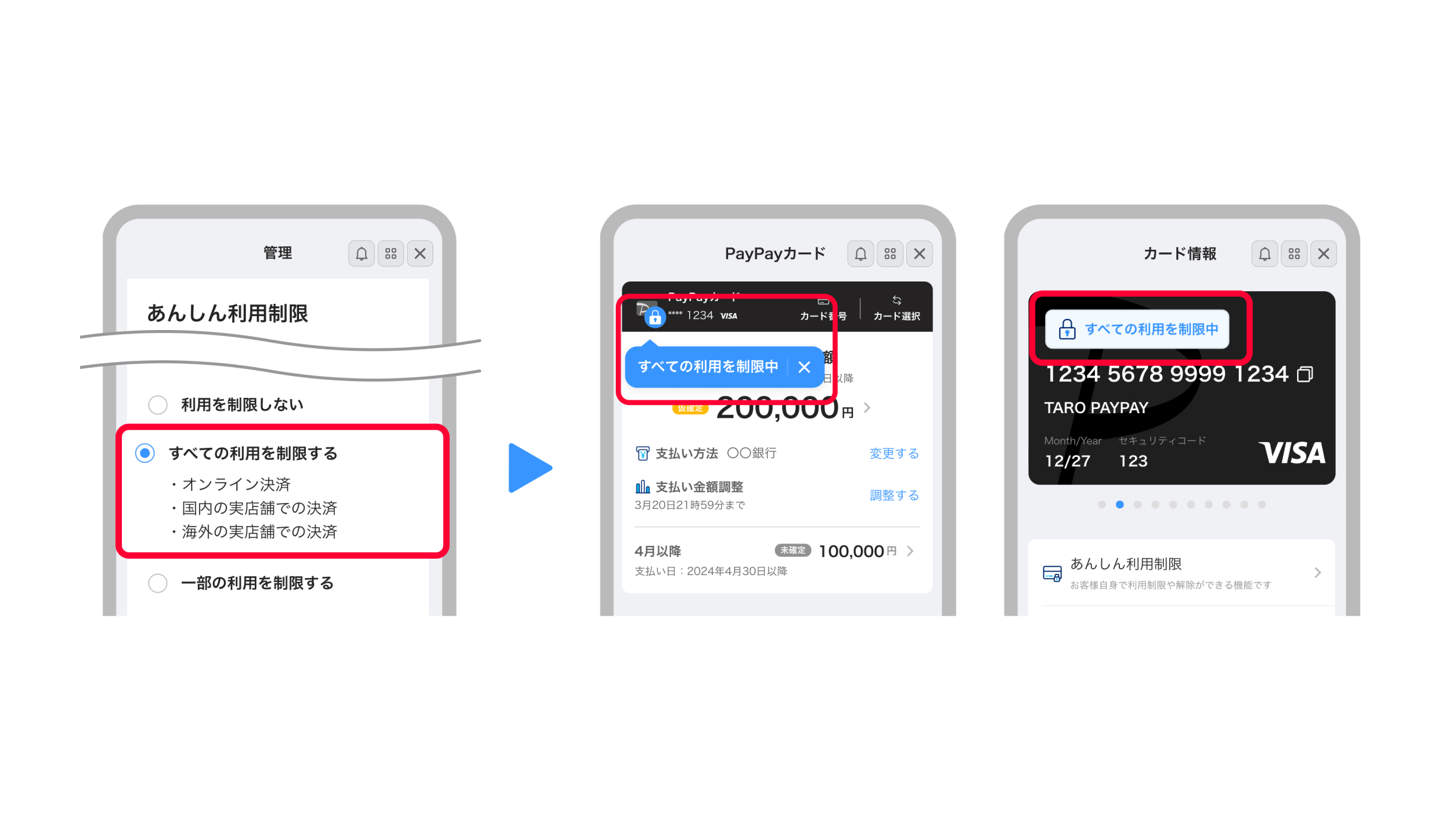
With the introduction of the Service, PayPay Card users will be able to either “Restrict Some Usage (online payments, in-store payments outside Japan, or both)” or “Restrict All Usage (online payments, in-store payments in Japan, and in-store payments outside Japan)”*2 for their credit card payments. This will allow users to restrict payment functionalities whenever the card is not in use and reduce the risk of fraudulent use by third parties. Restrictions can be disabled at any time.
The Service can also be used in emergencies, such as when a user receives an unexpected usage notification or suspects that the card may have been lost. Users can immediately and temporarily restrict the card’s payment features and then check usage details or whether the card has been lost, for a more secure experience.*3
*1. A feature that allows users to smoothly make reservations, order products, and purchase services provided by PayPay’s partner companies from the PayPay app.
*2. Certain payments are not available for the card lock feature, such as PayPay Credit and top-ups to PayPay Balance.
*3. The Service temporarily restricts features. In the event of unauthorized use or loss/theft, it is necessary to suspend the card and request a new one.
PayPay Card’s initiatives for safety and peace of mind
In recent years, damages from fraudulent use of credit cards have been on an upward trend.*4 PayPay Card has been implementing the following initiatives, in addition to the Service, to help PayPay Card users shop with their cards more safely and with greater peace of mind.
Safety Guidelines web page
To use credit cards safely and with peace of mind, it is important for users themselves to take an interest in security and have proper knowledge. PayPay Card has published the Safety Guidelines, a web page that enables users to check their own “safety level” and acquire know-how to be prepared in case of emergency.
Card usage alerts
This is a service that notifies users of card usage details at the time a PayPay Card is used.*5 By receiving notifications of the date, time, and amount of usage, users can identify unfamiliar transactions, if any, for greater peace of mind.
In addition, if a user notices an unfamiliar purchase through card usage alerts, using the new card lock feature will make it possible to temporarily restrict the card’s payment functionalities to first confirm the payment details.
Biometric authentication*6
PayPay Card has introduced biometric authentication in the PayPay Card mini app for the authentication necessary for viewing credit card information, such as credit card numbers and security codes. Because it is difficult to fake biometric authentication, the security has become more robust.
*4. Based on “Status of Damages from Fraudulent Use of Credit Cards,” published by the Japan Consumer Credit Association.
*5. Card usage alerts do not settle transactions.
*6. To use biometric authentication, users must register facial data or fingerprints on their device in advance.
PayPay Card and PayPay will continue to take a user-first approach, aiming to improve user satisfaction and create services that deliver more convenient and rewarding experiences, and will provide cashless services that become the indisputable industry standard in Japan.
■ About PayPay Card
PayPay Card Corporation changed its name from YJ Card Corporation on October 1, 2021, and began operations under the new appellation with the aim of becoming the leading card company in Japan. From October 2022, it became a wholly owned subsidiary of PayPay Corporation, further boosting synergy with the cashless payment service “PayPay.” The company will continue working to make users’ lives more convenient and provide more services that can be used across diverse payment scenarios.
■ About “PayPay,” the cashless payment service provided by PayPay Corporation
PayPay is a cashless payment service expanding across the country, available not only at major chain stores but also at small and medium size retailers, vending machines, taxis, and even public transportation. It can also be used in a variety of other scenes, including paying for online services and utility bills. PayPay is also expanding its range of services beyond just payments, including the Send・Receive feature (remittance/transfer and receiving of money) that allows users to transfer their PayPay Money and PayPay Money Lite balances between each other for free, or Earn Points, a service that allows users access to a simulated investment experience involving the exchange of PayPay Points with points provided by a service provider that PayPay is partnered with. The company also strives to create a safe and convenient environment for users through a hotline available 24/7 and a full compensation scheme ensuring, compensation for any damages that may be suffered.
PayPay Corporation is registered as follows:
・Prepaid Payment Instruments (third party type) Issuer, Registration #: Director-General of the Kanto Finance Bureau, No. 00710 (Registration date: October 5, 2018)
・Business Operator that Concludes Contracts on the Handling of Credit Card Numbers, etc., Registration #: Kanto (K) No. 106 (Registration date: July 1, 2019)
・Telecommunications Carrier (Filing #: A-02-17943 / Date filed: July 2, 2019)
・Fund Transfer Operator, Registration #: Director-General of the Kanto Finance Bureau, No. 00068 (Registration date: September 25, 2019)
・Notified Person Entrusted with Intermediation (Filing #: C1907980 / Date filed: December 18, 2019)
・Bank Agency Services (License: Director-General of the Kanto Finance Bureau (Gindai) No. 396 / Effective date: November 26, 2020)
・Financial instruments intermediary service registration number: Kanto Finance Bureau Director (Kinchu) No. 942 (Registration date: June 25, 2021)
・Electronic Payment Agency Services (License: Director-General of the Kanto Finance Bureau (Dendai) No. 109 / Registration date: February 14, 2023)
・Japan Payment Service Association (https://www.s-kessai.jp/, Date of admission: September 12, 2018)
・Japan Consumer Credit Association (https://www.j-credit.or.jp/, Date of admission: July 1, 2019)
* “PayPay” offers four types of electronic money and other services: PayPay Money, PayPay Money Lite, PayPay Points, and PayPay Gift Vouchers.
PayPay Money can be used to pay for partner services and in transactions at merchants if the transaction value is within the amount deposited into the PayPay account opened after completing an identity verification process. It can also be used for sending and receiving money between PayPay users free of charge. PayPay Money can also be cashed out to a designated bank account (no withdrawal fee if using PayPay Bank). The legal nature of this is an electromagnetic record which can be used to pay for goods and other services, and can be remitted or cashed out, and is issued by PayPay who is a Fund Transfer Operator registered under Article 37 of the Payment Services Act. Based on the provisions of Article 43 of the Payment Services Act, PayPay protects the debt it owes to its users in by depositing assets equivalent to or more than the debt amount. PayPay Money Lite is an electronic money issued by PayPay, which can be purchased and used to pay for services and merchants. PayPay users can transfer and receive PayPay Money Lite free of charge. The legal nature of this is a prepaid payment instrument issued by PayPay (Article 3, Paragraph 1 of the Payment Services Act). Based on the provisions of Article 14 of the Payment Services Act, PayPay protects the relevant assets for the purpose of protecting the owners of the prepaid payment instrument by providing a security deposit for issuance to the Legal Affairs Bureau in an amount equivalent to half or more of the unused balance of prepaid instrument methods as of March 31 and September 30. In addition, PayPay Points, which are granted through campaigns and promotions when using PayPay, can be used for partner services and in transactions at merchants in addition to PayPay Money and PayPay Money Lite. However, it cannot be transferred to other users or cashed out. PayPay Gift Voucher is a type of electronic money issued by PayPay, which can be used to make payments for affiliated services and merchants designated by the PayPay Gift Voucher. However, it cannot be transferred to other users or cashed out. PayPay Gift Vouchers have an expiration date. For details on the expiration date, see the conditions of the measures and campaigns that issue PayPay Gift Vouchers.
PayPay also strives to create a safe and secure environment for users. If charges that the user does not recognize occur due to unauthorized use by a third party on the user’s PayPay account, PayPay may provide compensation for the damage amount (after deducting any amount compensated by a third party), provided that prescribed compensation conditions are met. Please see Applying for compensation for details.
*Company names, trade names, and products/services in this press release are registered trademarks or trademarks of their respective companies.